


High Quality Hydraulic Jaw Chuck
Product Details
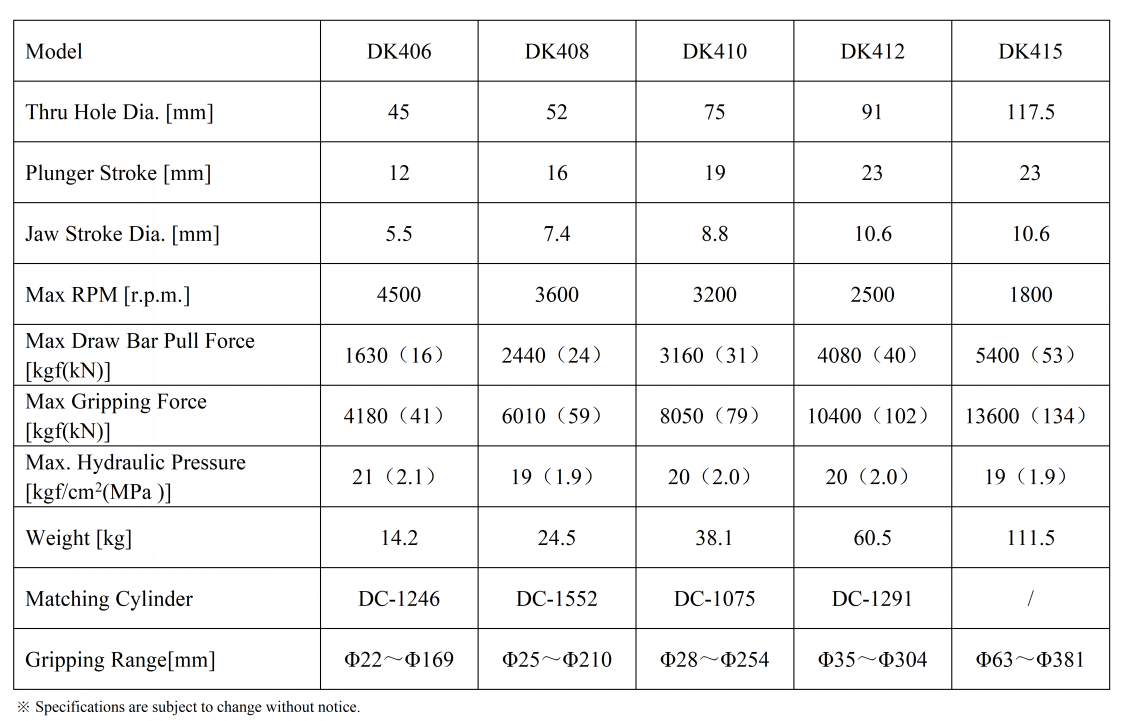
| Model | DK412 |
| Thru Hole Dia. [mm] | 91 |
| Plunger Stroke [mm] | 23 |
| Jaw Stroke Dia. [mm] | 10.6 |
| Max RPM [r.p.m.] | 2500 |
| Max Draw Bar Pull Force [kgf(kN)] | 4080(40) |
| Max Gripping Force [kgf(kN)] | 10400(102) |
| Max. Hydraulic Pressure [kgf/cm2(MPa )] | 20(2.0) |
| Weight [kg] | 60.5 |
| Matching Cylinder | DC-1291 |
| Gripping Range[mm] | Φ35~Φ304 |
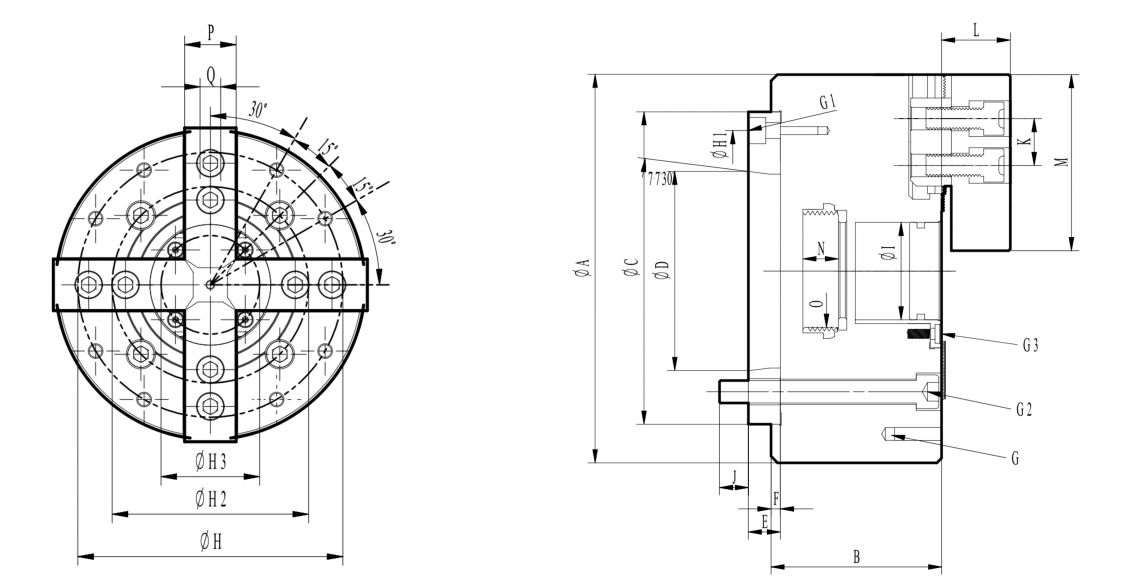
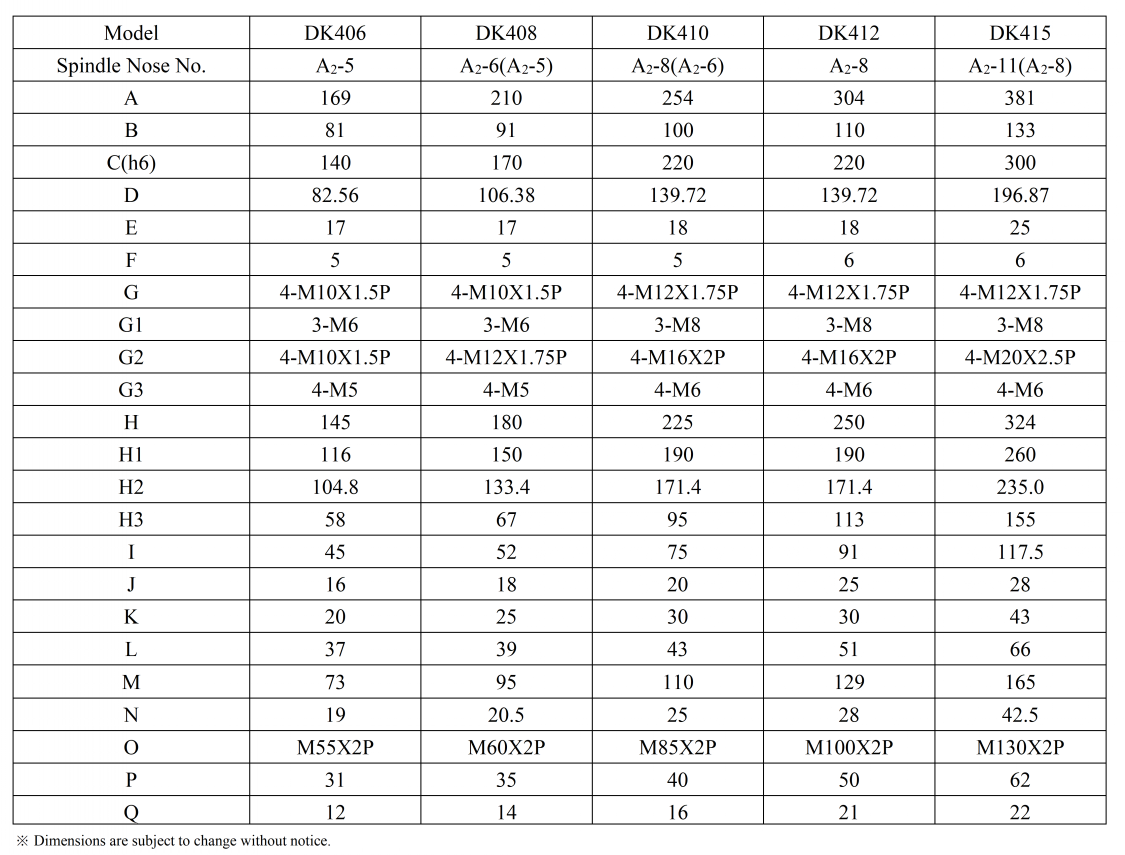
Model | DK412 |
Spindle Nose No. | A2-8 |
A | 304 |
B | 110 |
C(h6) | 220 |
D | 139.72 |
E | 18 |
F | 6 |
G | 4-M12X1.75P |
G1 | 3-M8 |
G2 | 4-M16X2P |
G3 | 4-M6 |
H | 250 |
H1 | 190 |
H2 | 171.4 |
H3 | 113 |
I | 91 |
J | 25 |
K | 30 |
L | 51 |
M | 129 |
N | 28 |
O | M100X2P |
P | 50 |
Q | 21 |
What factors determine the quality of a power chuck?
The quality of a power chuck is determined by several key factors:
Material Quality:
The materials used in manufacturing the chuck significantly influence its durability, strength, and resistance to wear and tear. High-grade steel and other alloys are often used for better performance.
Manufacturing Precision:
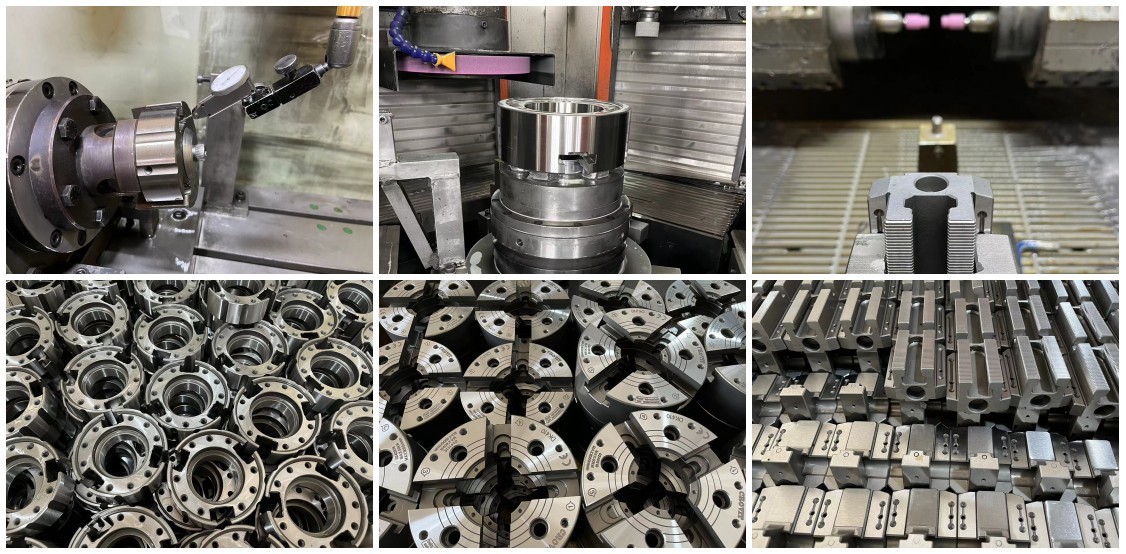
The degree of precision in the machining and assembly of the chuck affects its accuracy and alignment. High-quality chucks are manufactured with tight tolerances to ensure minimal runout and consistent performance.
Design:
The design of the chuck, including jaw configuration (e.g., hard jaws, soft jaws), body structure, and the mechanics of the clamping system, plays a crucial role in its functionality and ability to secure diverse workpieces effectively.
Hydraulic System:
For hydraulic chucks, the quality of the hydraulic system (including seals, valves, and hydraulic fluid) is vital. A reliable hydraulic system ensures consistent clamping force and responsiveness.
Clamping Force:
The maximum clamping force a power chuck can exert is critical to its performance, especially when dealing with heavy or awkward shapes. Higher clamping force generally indicates better gripping capability.
Operational Stability:
A high-quality power chuck provides stable clamping during the machining process, which minimizes vibration and enhances precision and surface finish of the workpiece.
Ease of Use:
The design should facilitate easy installation, operation, and adjustment. User-friendly features can enhance overall efficiency in a production environment.
Maintenance Requirements:
Quality power chucks are designed for low maintenance. They should allow for easy inspection and maintenance procedures without requiring excessive downtime.
Payload Capacity:
The chuck should be able to handle the weight and size of the workpieces typical for the applications it is intended for, without compromising safety or performance.
Brand Reputation and Standards:
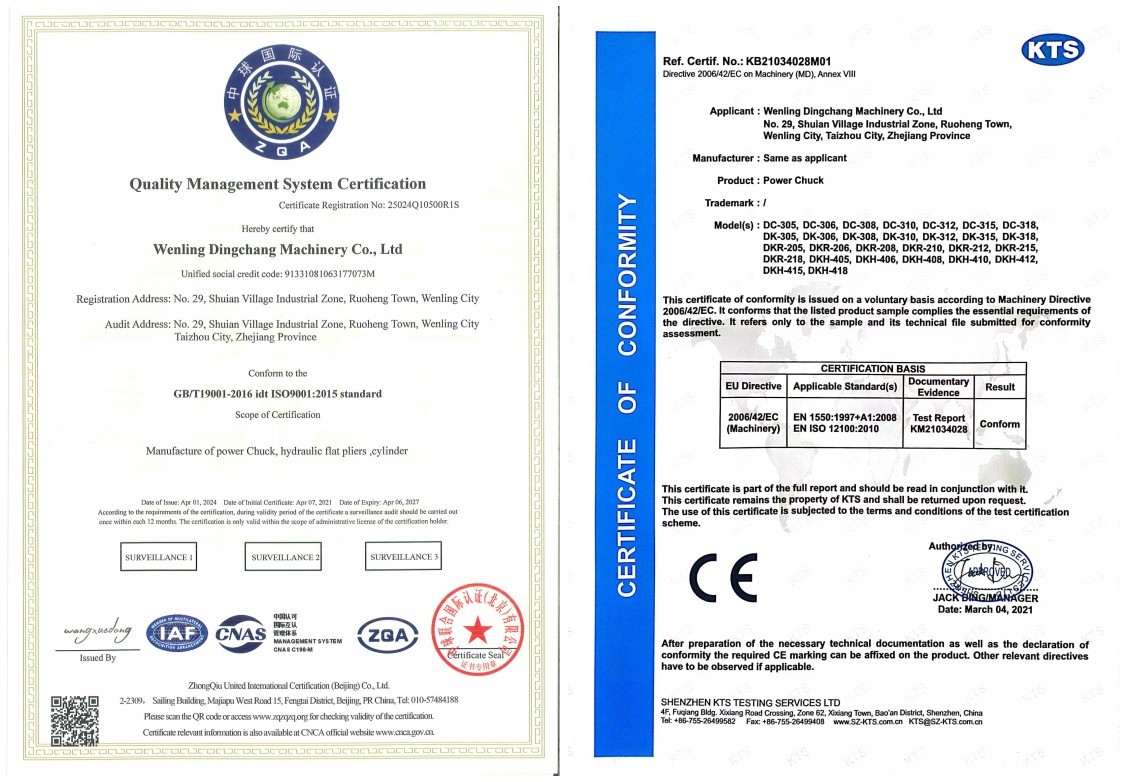
The manufacturer’s reputation and adherence to industry standards (like ISO certifications) can also be indicative of the chuck's quality. Established brands often provide robust warranties and customer support.
Understanding these factors can assist in selecting a power chuck that meets specific machining requirements and ensures long-term reliability and efficiency.

RELATED PRODUCTS
A hydraulic chuck tool holder is a type of tool holder that uses hydraulic pressure to securely hold cutting tools in place during machining operations, which is commonly used in CNC machining centers and other high-precision machining applications.
A hydraulic chuck is a type of workholding device commonly used on CNC lathes for securely gripping and holding workpieces during machining operations.
A power chuck is a type of workholding device commonly used in machining operations to securely grip and hold workpieces during turning, milling, drilling, or grinding processes. They are typically used on CNC lathes, machining centers, and other machine tools.
Hydraulic lathe chucks are commonly used in CNC lathes and other precision machining equipment to provide a strong and reliable grip on workpieces, ensuring stability and accuracy during turning, milling, drilling, or grinding processes.
GET A FREE QUOTE
CONTACT US
WhatsApp / Mobile: +86-159-67056767
Tel: +86-576-89932067
Add: Building 8, Wanyang Crowd Innovation Park, Wenling, Zhejiang, China
GET A FREE QUOTE
FOLLOW US


Copyright © 2024 Magrab Machinery (Taizhou) Co., Ltd. ALL Rights Reserve.